
Flat roofs get a bad reputation they don’t always deserve, especially across older properties in Greater Manchester where garages, extensions and outbuildings almost always carry some form of flat covering. Most of the horror stories about leaks and short lifespans come down to the wrong system being installed badly, not flat roofing itself being a poor choice. EPDM, felt and GRP are the three systems you’ll come across most often, and each behaves quite differently once it’s actually on your roof. A well-installed EPDM roofing Greater Manchester job, for example, can outlast a badly fitted felt roof by decades, even though felt looks cheaper on paper.
The mistake a lot of homeowners make is comparing these systems purely on installation price. That’s understandable, since quotes vary a fair bit, but price alone tells you almost nothing about how the roof will perform years down the line.
A more useful comparison looks at lifespan, how each system handles Manchester’s weather, ongoing maintenance, and whether it actually suits the roof you’re dealing with.
What Makes a Flat Roofing System Suitable for Greater Manchester?
Rain is the obvious starting point. Greater Manchester doesn’t just get a lot of rainfall, it gets changeable weather that shifts between wet, dry, warm and cold within the same week. A flat roofing system needs to cope with that without expanding, contracting or cracking every time conditions change.
Water pooling is one of the bigger practical concerns on any flat roof. Even a slight fall in the design should direct water toward drainage points rather than letting it sit, since pooling is one of the most common causes of eventual leaks.
Installation quality affects every one of these systems more than the material choice itself. A poorly prepared roof deck or badly sealed joint causes problems regardless of whether it’s EPDM, felt or GRP on top. This applies just as much if you’re comparing quotes from a roof replacement company handling a pitched section of the same property, since preparation standards should be consistent across the whole job rather than treated differently by roof type.
Maintenance requirements vary between systems, and so does how forgiving each one is if maintenance gets missed for a season. Suitability also depends on what the roof is actually for, since a garage roof has different demands to a roof over a living space.
EPDM Roofing Explained
EPDM is a synthetic rubber membrane, and it’s become one of the more popular flat roofing options for good reason. It comes in large sheets, meaning fewer joints and fewer weak points compared to some other systems.
Flexibility is where EPDM stands out. It expands and contracts with temperature changes without cracking, which suits Greater Manchester’s shifting weather reasonably well. It also holds up to UV exposure and general weathering better than older felt systems tended to.
You’ll typically see EPDM used on extensions, garages, dormer roofs and other smaller flat-roof structures, though it’s also common on larger commercial applications. It’s genuinely versatile, not a niche product for one type of building.
Installation needs correctly bonded seams and secure edge detailing, otherwise you lose a lot of the benefit that makes EPDM worth choosing. Once installed well, long-term maintenance is fairly minimal, mostly occasional visual checks and keeping drainage points clear.
Felt Roofing Explained
Felt roofing has been around for decades, and modern felt systems are a fair bit better than the older versions many homeowners remember. Today’s felt is usually installed in multiple layers, torched or bonded together, rather than the single-layer systems that gave felt roofing a poor reputation in the first place.
Felt can still be practical, particularly on smaller roofs or where budget is a genuine constraint. It’s generally one of the more affordable systems upfront, which matters for some projects more than others. That said, if you’re already thinking ahead to a future flat roof replacement, it’s worth weighing felt’s shorter lifespan against the saving now, since a cheaper system that needs replacing sooner isn’t automatically the better long-term option.
Cost aside, felt does tend to need more regular maintenance than EPDM, and its expected lifespan is usually shorter. That’s not a dealbreaker if properly maintained, but it’s worth having realistic expectations rather than assuming it will behave like a longer-lasting membrane.
Installation quality plays a bigger role with felt than with some other systems. Poorly sealed laps and joints are one of the most common causes of felt roof leaks, so it’s a system where cutting corners tends to show up fairly quickly.
GRP Flat Roofing Explained
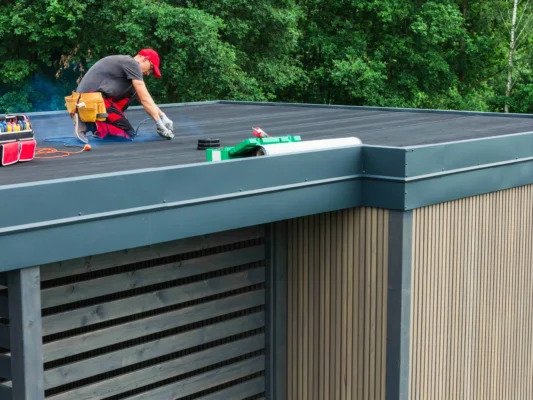
GRP, more commonly known as fibreglass roofing, is applied as a liquid that cures into a solid, joint-free surface. That joint-free finish is one of its main selling points, since there are no joints or seams for water to find a way through.
The finished appearance is smooth and often preferred for visible flat roofs, such as those over extensions where the roof might be seen from upstairs windows. GRP also has strong resistance to standing water, which suits roofs that don’t have perfect drainage falls built in.
You’ll commonly find GRP used on garages, extensions and smaller domestic flat roofs, largely because it works well on a range of shapes and can be dressed neatly around upstands, kerbs and rooflights.
Installation requires the right conditions and correct curing, since GRP is more sensitive to temperature and moisture during application than a membrane system. Repairs are generally straightforward for a competent installer, and maintenance mostly comes down to occasional inspection rather than anything intensive.
EPDM vs Felt vs GRP: Which Performs Best?
Putting these three side by side makes the trade-offs clearer, though none of them wins outright across every category.
On lifespan, EPDM and GRP tend to outlast felt, often by a decade or more when installed correctly. Felt’s shorter lifespan is offset somewhat by its lower upfront cost, which is why it still gets specified on some projects.
On installation cost, felt usually comes in cheapest, GRP sits in the middle, and EPDM can vary depending on the size and complexity of the roof. Weather resistance is strong across all three when installed properly, though EPDM’s flexibility gives it a slight edge in coping with temperature swings without stress cracking.
Maintenance needs are lowest for EPDM and GRP, with felt generally requiring closer attention. Appearance tends to favour GRP for a smooth, unbroken finish, while EPDM and felt both have a slightly more textured look that’s less noticeable once the roof is finished.
None of this makes one material universally better. Whichever system a contractor recommends as part of our residential roofing services should come down to the roof’s size, shape, drainage, budget and how long you want it to last before thinking about it again, rather than a one-size-fits-all default.
Flat Roof Systems for Extensions and Garages
Smaller domestic flat roofs, like those over single-storey extensions or garages, don’t always need the same specification as a larger commercial roof, but they still deserve proper consideration rather than being treated as an afterthought.
Access matters more than people expect. A garage roof that’s easy to reach might suit a system that needs occasional maintenance, while a roof that’s harder to reach, tucked behind other structures, might benefit more from a lower-maintenance option like EPDM or GRP.
Drainage on smaller roofs can be trickier to get right, since there’s less surface area to work with and falls need to be built in carefully during installation. Existing roof condition also plays a part. If the deck underneath is sound, that opens up more system options than if remedial work is needed first, and the roof’s purpose and construction should genuinely influence which system gets recommended, rather than defaulting to whatever’s quickest to quote.
Getting the Right Flat Roofing System for Your Property
Start with a proper inspection of the existing roof and the structure beneath it. Skipping this step and jumping straight to material choice is how mismatched systems end up installed on roofs they were never really suited to.
Think about expected lifespan alongside maintenance needs. A system that lasts longer but needs more attention might not actually suit a busy household better than one that’s slightly shorter-lived but easier to leave alone. A clear quotation should cover preparation, materials and installation separately, not just a single lump figure, since that breakdown makes it much easier to compare like for like against another contractor’s price.
Comparing EPDM, felt and GRP properly takes a bit of back and forth, and it’s worth getting professional advice rather than guessing based on general information online. If you’d like that kind of straightforward opinion on your own roof, connect to us and we’ll take a proper look before recommending anything.
Getting this decision right at the start saves a lot of hassle later. The wrong system on the wrong roof tends to show its problems within the first couple of winters, while the right one, installed properly, can genuinely be left alone for years at a time.
